How do I pick a web design
company for my practice?
Three questions tell you which type of company to shortlist. A weighted scorecard and a 10 minute call tell you which one to hire.
The short answer
Three questions, then a scorecard
Answer three questions about your practice to learn which type of company to shortlist, then score three companies on six weighted criteria and hire the highest total. Before you score, open each company's live practice sites on your phone and give each one the same 10 minute call.
Three names is enough to compare prices and few enough to check in a week. Score from what you saw working and what is in writing, not from how friendly the call felt.
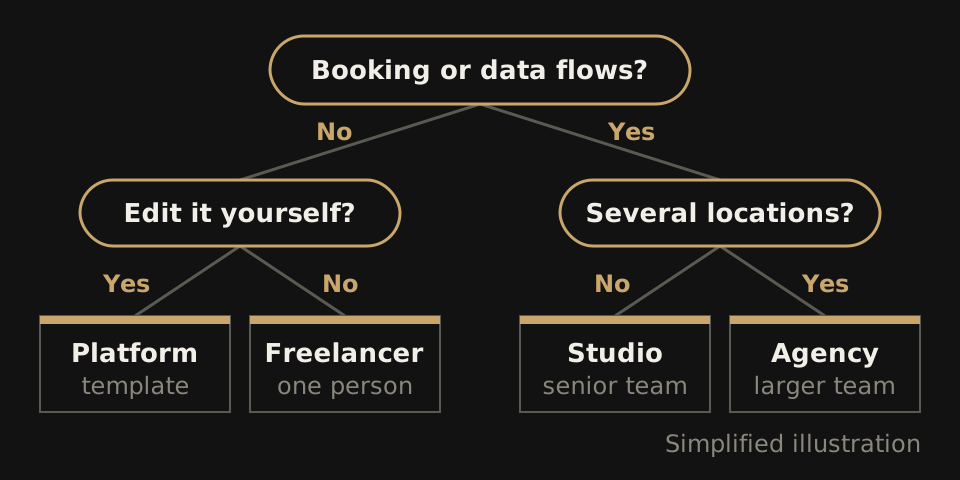
Run the three questions in order
Each answer crosses a type of company off your list or adds one. Write the survivors on a sticky note before you search for names.
- Does booking or patient information need to flow somewhere?
- No. Patients call, or a short form emails the front desk. A template platform or a freelancer can handle it. On a platform you spend your own hours; with a freelancer you depend on one person.
- Yes. Requests must reach your scheduling software or the right office. Cross off template platforms unless your booking system gives you a link that works on a phone. Keep a freelancer only if they show you a live site with the same connection. Otherwise, shortlist a studio.
- Do you have more than one location or provider?
- One office, one or two providers. A freelancer or a studio. Ask a freelancer who covers when they are sick or fully booked.
- Several providers or offices. A studio or a larger agency. Each office needs its own page, hours and booking route (see dental group websites). A larger agency fits when you also want ads and content run every month, but the people on the sales call may not do the work.
- Do you need to edit it yourself?
- Yes, weekly. Favor a template platform if question 1 was no, or a custom build whose editor you have seen. Get the list of what staff can change in writing.
- Rarely. Leave changes to the company. Ask the price per change and how fast it happens.
If two types survive, choose two names from the stronger type and one from the other, so the scorecard compares two approaches.
Score three names on six weighted rows
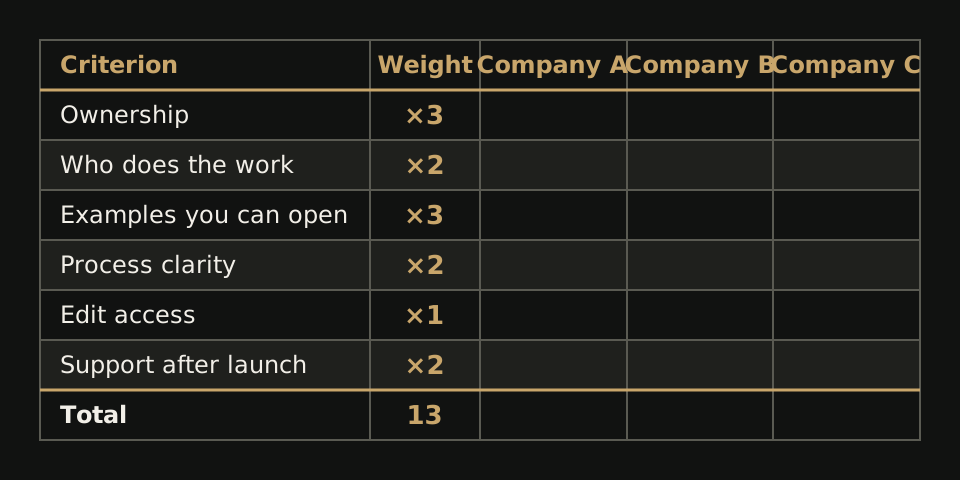
Score each company 0 to 3 per row, multiply by the weight, then add each column. If you answered yes, weekly, at question 3, change the edit access weight to 3; the maximum then moves from 39 to 45.
| Criterion | Weight | What earns a 3 | Company A | Company B | Company C |
|---|---|---|---|---|---|
| Ownership | 3 | The contract names you as owner of the domain, code, content and analytics, and states the cost to leave. | |||
| Who does the work | 2 | You have met the person who designs and builds it, and they join your review calls. | |||
| Relevant examples you can open | 3 | A live practice site with your booking setup or your location count, opened on your own phone. | |||
| Process clarity | 2 | Written steps, dates, revision rounds and a list of what you must supply. | |||
| Edit access | 1 | You saw the editor, and what staff can change is listed in writing. | |||
| Support after launch | 2 | A named window for fixing what breaks, and a written price for changes. | |||
| Total | 13 (max 39) |
Said, written, shown: one rule for every row
- 0: no answer, or not offered.
- 1: they said it on a call.
- 2: it is in the proposal or contract.
- 3: it is in writing and you saw it working.
So “you own the site” said on a call is a 1. A contract naming you as owner is a 2. That contract plus a handoff list from a past client is a 3. A portfolio screenshot never scores above 1 for examples; a live site where you tap through to the booking step can earn the full 3.
A hypothetical example. A two-office physical therapy practice needs booking to reach its scheduling software. The freelancer builds everything personally, but showed only a screenshot (1) and has a contract naming the practice as owner with no handoff list (2): 6 + 6 + 3 + 2 + 2 + 2 = 21. The agency has a strong process and support plan, but its contract only licenses the site (1) and a salesperson ran the call (1): 3 + 2 + 6 + 6 + 1 + 6 = 24. The studio showed a live two-location site that booked on the owner's phone, plus a contract and handoff list naming the practice as owner: 9 + 4 + 9 + 4 + 2 + 4 = 32. The lead comes from the two rows weighted 3, so a pleasant call cannot outscore ownership and proof you opened yourself.
The shortlist call: 10 minutes
Give all three the same questions in the same order, with a timer running. You are filling the scorecard, not hearing a pitch.
- Minutes 0 to 2: read them your three answers. A good company repeats back what it heard.
- Minutes 2 to 5: “Send me a live site where patients book the way mine would.” Open it on your phone while they talk.
- Minutes 5 to 7: “Who designs it, who builds it, and who do I email the week before launch?” You want names, not titles.
- Minutes 7 to 9: “If we part ways a year after launch, what do I leave with?”
- Minutes 9 to 10: “What do you need from me, and when do I get a written scope?”
Score each row right after you hang up. A company that cannot answer inside ten minutes has just filled in its process clarity row.
When the scores are close, read the quotes
If first and second place sit within a few points, the quotes decide. Two proposals at different prices often describe different jobs: one includes writing and URL redirects, the other leaves them out. Put your top two into the website quote comparison tool, which keeps anything a quote skips marked “Not stated” until the company confirms it in writing. Every scorecard row below 2 becomes a question for your final call.
Before you sign, confirm the winning quote lists a page for each office and provider, names the booking step as a deliverable and includes redirects from your old page addresses.
Where WTM Studio lands on the tree
We are a custom studio, so we fit practices that answered yes at question 1 or that have several providers or offices. Founder Ray Hussain leads every project, so the person on your shortlist call runs the build. We work from Miramar, Florida, for practices nationwide. If you have one office, patients who call and staff who will edit weekly, pick a template platform instead.
Score us on the same six rows as everyone else. You get a free homepage concept then one flat quote; redesigns typically cost $6,000 to $30,000 one time (see pricing). No retainer is required, you own what we build, and most sites launch in 2 to 4 weeks after the design direction is approved.