Red flags when hiring
a web design agency
Twelve warning signs sorted by how hard to react, for practice owners holding two or more quotes side by side.
The short answer
The flag most people miss
The worst red flags when hiring a web design agency are about control and scope: the agency keeps your domain, code or accounts in its own name, or the quote never says in writing what you are buying. Of those, the domain is the one owners forget to ask about, and it is the hardest to get back later.
WTM Studio puts its answer to every flag below in writing. Run us through the matrix the same way you would run any other agency.
Why the domain outranks every other flag
Most flags cost money. This one costs control. If the domain sits in an agency's registrar account, they hold your web address, the email your front desk runs on and every old URL patients reach from search. Leaving means asking permission to take your own name with you.
It slips past because it sounds like help: “We'll set up the domain for you.” Then renewals go on their card, the login goes to their inbox, and years later nobody at the practice knows where it lives.
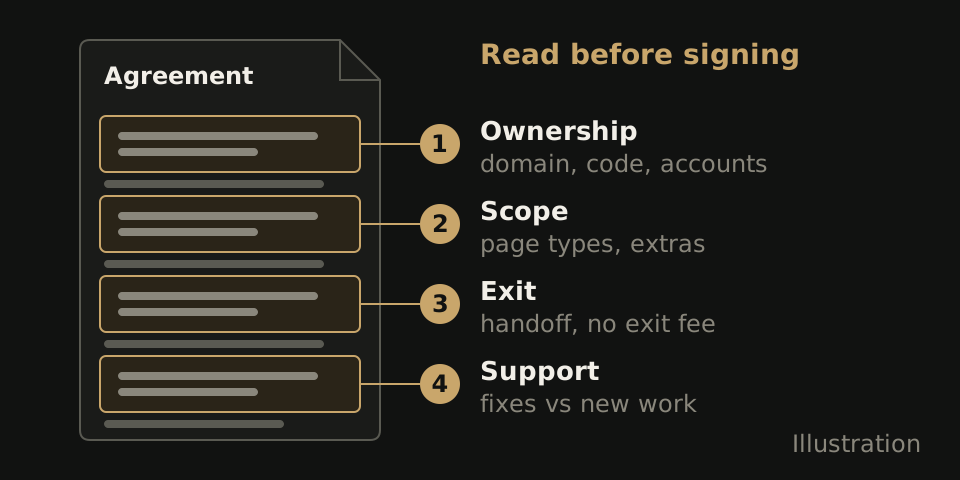
Fix it before you sign. Register the domain under an account your business controls and add the agency as a user. Do the same for hosting and analytics. Our website quote comparison tool gives ownership its own line, so every agency answers the same question.
Twelve flags and how hard to react
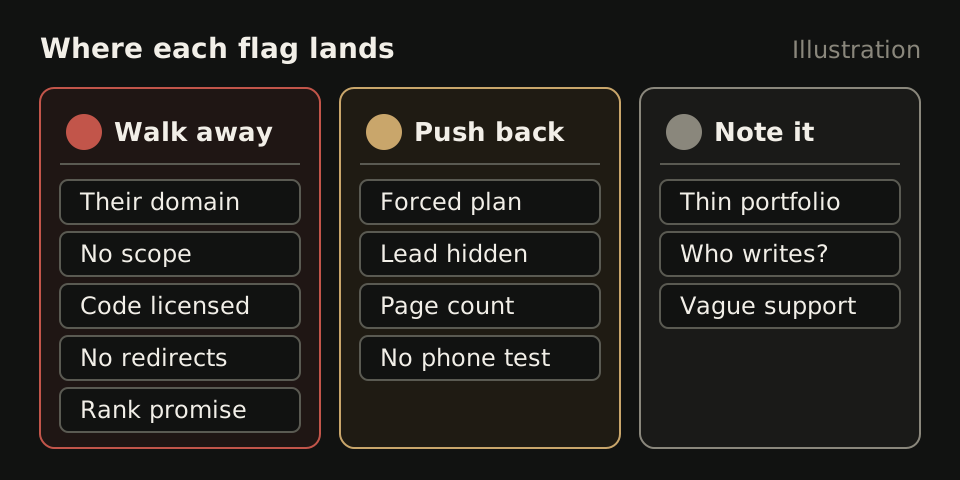
Walk away means the problem is built into the deal. Push back means ask for the fix in writing and watch the reaction. Note it means it is cheap now and expensive if nobody checks it at launch.
| Flag | What it sounds like | Why it costs you | Severity |
|---|---|---|---|
| Domain in the agency's account | “We'll register it so you don't have to deal with it.” | Your address, email and search history live in their login. Every renewal and DNS change goes through them. | Walk away |
| No written scope | “We handle everything. We'll sort out the pages as we go.” | Unnamed work can't be checked at launch, and every addition turns into a new invoice. | Walk away |
| Code or design stays theirs | “The site is licensed to you while you're a client.” | Cancel and you start from a blank page. | Walk away |
| No plan for old URLs | “The new site just replaces the old one.” | Pages that earned search traffic break or get dumped on the homepage. The redesign SEO checklist shows what a plan looks like. | Walk away |
| Guaranteed rankings or patients | “Page one, guaranteed.” | No agency controls search results. The promise tells you how they sell. | Walk away |
| The site only works on a monthly plan | “The price is low because it comes with the plan.” | You pay for the build many times over, and leaving costs more than staying. See monthly vs one-time builds. | Push back |
| You never meet the project lead | “You'll meet the team after kickoff.” | The person who understood your practice on the sales call is not the one making design calls. | Push back |
| Page count instead of page types | “Fifteen pages, one price.” | A repeated service layout and a booking flow are different jobs. A count hides which one you're getting. | Push back |
| No phone testing plan | “Don't worry, it's responsive.” | A layout that resizes is not the same as someone tapping through the booking route before launch. | Push back |
| Portfolio with no detail | “Here are some sites we've worked on.” | “Worked on” could mean the full build, one page or a mockup. Ask which pages they built. | Note it |
| Nobody owns the words | “Just send us your content when it's ready.” | Launch waits on you writing service pages at night, and the design gets built around filler text. | Note it |
| Support is a shrug | “Email us if anything comes up.” | With no line between a fix and new work, every request gets priced on the spot. | Note it |
Three ways it goes wrong, slowly
The domain hostage. A practice owner decides to switch agencies. The new team asks for registrar access. The old agency takes weeks to reply, then sends an invoice for “transfer administration.” Appointment emails still run through that domain, so every day of stalling hurts the practice, not the agency. The owner pays. Nobody had asked who held the login.
The pretty launch. A med spa launches a redesign that looks far better than the old site. Weeks later the front desk notices fewer calls about one treatment. That treatment's old page was the one people found in search, and it now returns a 404 because nobody listed the old URLs before the switch.
The page count. A dental group with several offices signs a quote for a set number of pages. Each office needs its own page with hours, providers and a booking route. The agency calls those custom and sends a change order for each location. The original price was real. It was for a different site.
Six green flags that beat a nice portfolio
A good agency raises these before you ask.
- They ask who owns your domain. On the first call, and they want the answer in writing.
- The scope names page types. Service pages, location pages, booking and forms, plus a line for what costs extra.
- You meet the lead before you sign. That person is still on the calls in week three.
- They ask for your current URLs. A redesign quote with no mention of redirects is a quote for a new site, not a move.
- You see design direction before the full price. A concept of your own homepage says more than a deck of past work.
- Leaving is boring. The agreement lists what you take with you, and there is no fee for taking it.
Try it on two quotes. Picture a hypothetical three-office practice holding two bids. Quote A reads “15 pages, $9,000.” Quote B costs $12,500 and lists 8 service pages, 3 location pages, booking, redirects for the 60 current URLs and a line keeping the domain in the practice's account. Score A against the matrix: no redirect plan is a walk away flag, a bare page count is a push back, and silence on the domain is the first question to ask. Send A the gaps in writing, then compare.
Still deciding between a solo designer and a studio? Our freelancer vs agency guide covers the final interview and handoff.
What WTM Studio puts in writing
- Ownership. You own what we build, and no retainer is required to keep it.
- Scope and price. A free homepage concept first, then one flat quote. Website redesigns typically run $6,000 to $30,000 as a one-time project. The pricing page explains what moves a job within that range.
- The lead. Founder Ray Hussain leads every project, so the person on the first call makes the design decisions.
- Timing. Once you approve the design direction, the site launches in 2 to 4 weeks.
If our quote leaves something out, the matrix above is how you catch it. We are based in Miramar, Florida and work with practices nationwide.