How much does a website cost
for a small business?
Seven questions put your project in a scope band. A checklist covers the bills that arrive after launch, so you can size the job before you compare quotes.
The short answer
Scope sets the price, not page count
A small business website costs what its scope costs, not what its page count suggests. At WTM Studio, redesigns typically cost $6,000 to $30,000 one time, and the seven questions below show if your project is Simple, Standard or Complex before any quote arrives.
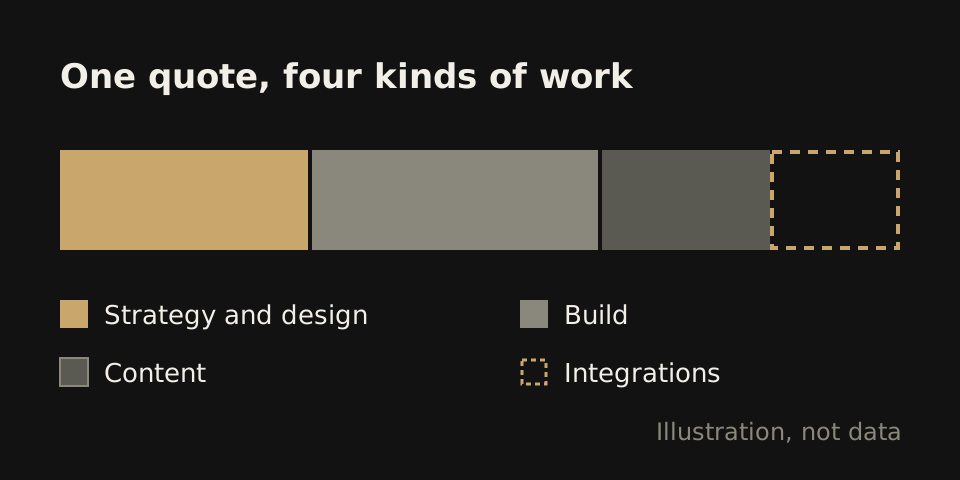
Scope means the kinds of pages, who edits them, the systems they connect to and the writing behind them. Here is how two quotes split. One 12-page quote includes writing every service page, moving the old blog and connecting online booking. Another 12-page quote assumes you hand over finished text and want a contact form. Same page count, but the first is a far bigger job, and neither provider is lying to you.
The calculator works with any provider, so you can use the same score for every quote you collect.
Score your project in seven questions
Pick one answer per row and write down its points. Stuck between two columns? Take the higher one, because quotes tend to split on exactly those rows.
| Scope question | Low: 1 point | Medium: 2 points | High: 3 points |
|---|---|---|---|
| How many page types? | One or two layouts, reused | Three to five, such as services, team and FAQs | Six or more, or a deep library of treatment or product pages |
| Who edits it after launch? | Almost nobody; changes are rare | Staff update text and photos on set pages | Several people publish new pages, posts or offers every month |
| Booking or payments? | A contact form and a phone link | An existing booking tool, linked or embedded | Booking by location or provider, or payments taken on the site |
| How many locations? | One | Two or three | Four or more, each with its own page |
| Custom content system? | No; a standard editor is fine | Some structured fields, such as team profiles | A custom CMS built around your content |
| Migration of old content? | Nothing worth keeping | A handful of key pages and their URLs | A large library of pages, posts and URLs with redirects |
| Integrations? | Analytics only | One or two, such as an email list or reviews | Three or more, or data passing both ways with a CRM |
Add the seven numbers. Your total will fall between 7 and 21.
What your total says about the job
| Total | Scope band | What the build usually involves |
|---|---|---|
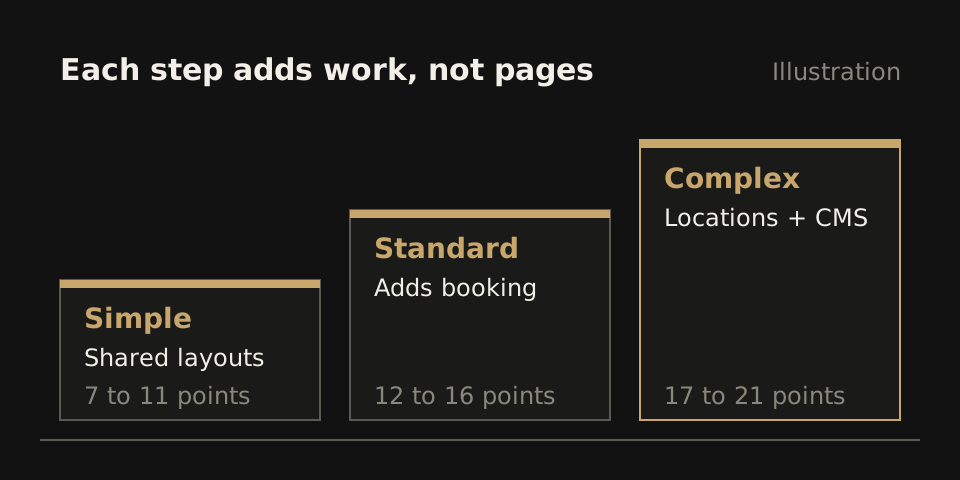
| 7 to 11 | Simple | A few shared layouts, one location, a form or booking link, little to migrate. Most of the effort goes into design and words. |
| 12 to 16 | Standard | Several page types, staff editing, an embedded booking tool, some old pages carried over with their URLs. |
| 17 to 21 | Complex | Deep page collections, several locations, connected booking, a custom content system or a big migration. Planning and testing become real line items. |
Two answers matter more than the total. A 3 on the custom content system question is the single answer most likely to push a quote up, because the editing tools get built for your content instead of borrowed. A 3 on booking means every location, provider and confirmation has to be tested on a phone before launch.
The bands carry no market price, on purpose. Two providers can quote the same band far apart, because they put different people on the work and include different things.
Two hypothetical businesses, same page count
This example is made up, so treat the numbers as illustrative. Two businesses each want about 15 pages. Watch which questions move the score.
- A one-office accounting firm. Three page types (services, team, contact), staff who update team bios, a contact form, one office, a standard editor, five old pages worth keeping, and analytics plus an email list. Score: 2 + 2 + 1 + 1 + 1 + 2 + 2 = 11. Simple, right at the line.
- A three-clinic physical therapy practice. Six page types including conditions and locations, front desk staff posting monthly offers, booking by clinic, structured therapist profiles, a 60-post blog that needs redirects, and booking, reviews and email tools connected. Score: 3 + 3 + 3 + 2 + 2 + 3 + 3 = 19. Complex.
Same page count, eight points apart. Before comparing prices, the practice should ask every provider two things: how they will test booking for each clinic on a phone, and who maps the 60 old blog URLs to their new addresses. A quote that answers neither has probably priced a smaller job.
See how scope plays out for dental practice websites, multi-location dental groups and med spa websites.
Costs that are not in the quote
A build quote pays for the build. These bills come from elsewhere, and most repeat. Tick each one off.
- Domain name. Renewed every year with the registrar. Keep it in your own account, not your designer's.
- Hosting. Ask where the site will live, who pays the host and what the plan covers.
- Booking tool subscription. The website connects to the booking system. The system itself bills you separately.
- Email tool subscription. Newsletters, automated reminders and business inboxes each carry their own fees.
- Photos. A shoot of your team and space, or licensed images. Agree who supplies them and who holds the rights.
- Copywriting. Check if the quote writes the pages or expects finished text from you. This one line explains a lot of gaps between quotes.
- Ad spend. Money paid to ad platforms is separate from any fee to manage the ads, and both sit outside the website.
If a quote does cover one of these, get it named in writing, along with what happens at renewal.
Take your score into every quote conversation
Send each provider the same seven answers. Ask them to price that scope and to list what they left out. Now the quotes describe the same job, so the gap in price means something.
The free website quote comparison lines proposals up side by side. If a quote mixes monthly fees into the build, read monthly subscriptions vs a one-time build. Scored Simple? A template might do the job, and custom websites vs templates will help you decide. Scored higher, start with custom website design.
Where our price lands
Your score tells you which end of the $6,000 to $30,000 range to expect if you work with WTM Studio. You get a free homepage concept then one flat quote, agreed before work starts. Once the design direction is approved, most sites launch in 2 to 4 weeks.
Founder Ray Hussain leads every project from Miramar, Florida, for businesses nationwide. There is no required retainer, and you own what we build. More detail is on the pricing page.