Custom Website Design vs Templates:
Which Is Right for Your Business?
Choose a template or AI builder for a straightforward site you can manage yourself. Choose WTM for a custom redesign with design, content, and development handled by one team.
Redesigning your business website without an in-house web team? Compare the work, ownership, and support behind each option.
Explore the case study
The short answer
Choose for the finished experience.
A template can fit a straightforward brief. An AI builder can help you create and revise a site yourself. Choose WTM when you want a custom website, a named project lead, and a scope built around what your customers need to understand and do.
What is a template website? A template website uses a pre-made design shared by many sites, with your words and photos added in place of the samples. A custom website is designed for your business.
This is WTM’s perspective as a custom website studio. Platform capabilities vary. Compare the actual scope, people, and terms.
Three approaches.
Different responsibilities.
| Decision | Template | AI website builder | WTM custom-built |
|---|---|---|---|
| Where it starts | An existing layout you adapt to your content. | A generated starting point you review and refine within the chosen platform. | Your business, real content, and the path your customer needs. |
| Who makes it work | You or a hired specialist handles the content, setup, and testing. | You or your specialist checks the facts, configuration, and finished flows. | Ray leads the project. Design and development stay together. |
| What you agree | The theme or platform terms, plus any specialist work you need. | The platform plan, operating costs, and any outside help. | Your design direction first. An agreed scope and flat quote before the build. |
| What you control | Check account access, licenses, editing, and export limits. | Check those same terms. An AI label does not establish ownership. | You own the work. Confirm the accounts, integrations, and handoff in the scope. |
The WTM difference
Designed around
your next chapter.
See it before you commit.
See a custom design direction for your business first. Then decide on the scope and flat quote for the full build.
Know who’s leading it.
Founder Ray Hussain leads every project. Your business has a named person responsible for the direction.
Make every page count.
The work starts with what customers need to find, understand, and do. Design, content, and the path to contact belong in the same conversation.
Northside Dental · Client-reported results
A real business.
A measurable first month.
20%+more new patients.
In the first month: 57 new patients vs a prior average of 47, practice-reported.
Client-reported counts for the first month after launch. This comparison does not establish that the website alone caused the increase or predict another business’s results.
See the build and source
Is a template enough for a simple service website?
Yes, if you need a few service pages and a clear inquiry path, and the template fits your actual content. Put your writing and photography into it before deciding. If the layout forces you to hide important information or makes the next step unclear, compare a custom approach.
A template is a starting design, not a finished service. Someone still needs to check the writing, set up the tools, test the mobile path, and maintain the site. Include that work when comparing proposals.
Where do AI website builders fit?
They can be useful when you want to create and revise a site yourself. For example, Wix describes a prompt-based creation flow with further customization and business tools. Evaluate the actual platform rather than assuming every builder has the same limits.
Try a real customer task before publishing. Can someone understand the offer, choose the relevant service, and complete an inquiry on a phone? Check the accuracy of every business claim and confirm that the inquiry reaches you.
Our AI website builder versus agency guide goes deeper into what a finished launch needs. WTM’s service is custom website design and development.
When does custom become worth it?
When your website needs to reflect how your business actually works. Different audiences, substantial service content, several locations, or connected booking systems can all change the design brief. Describe the customer’s problem before choosing the approach. Running several dental offices? See website design for multi-location dental groups.
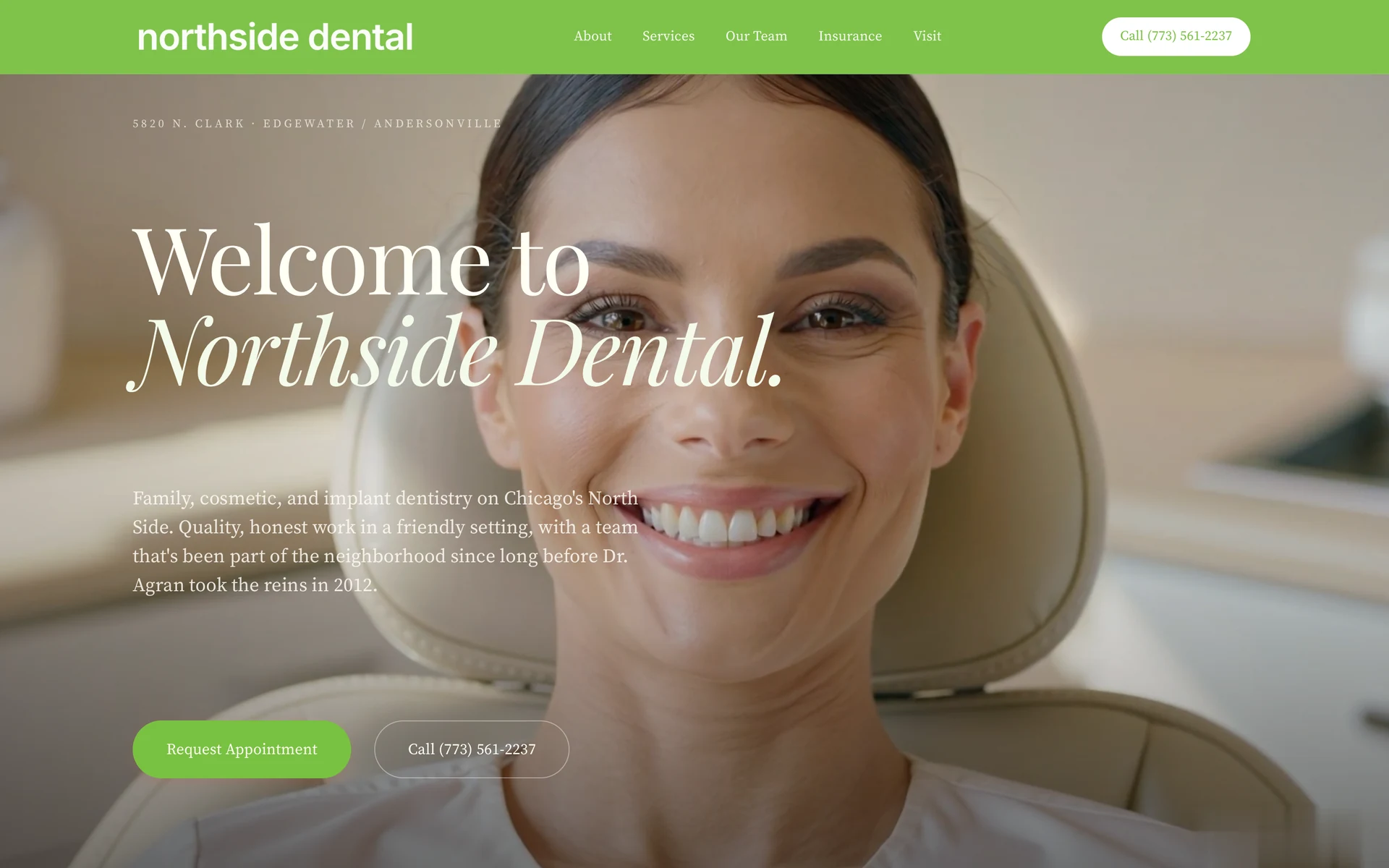
For Northside Dental, that meant presenting a practice, its services, doctors, insurance information, and appointment path. For Back to 30, it meant helping visitors find treatments and four clinic locations. Different businesses call for different decisions.
Ask to see those decisions in the work. A polished homepage matters. So does what happens when a visitor needs a specific service or is ready to get in touch.
What does a WTM website cost?
New websites and redesigns cost $6,000 to $30,000 as a one-time project. Your page types, content, integrations and migration requirements shape the final quote. Apps are custom-quoted separately. For enterprise websites, meaning brands with hundreds of locations and thousands of pages, contact us for a quote.
See your design direction first. Then agree the work and flat quote before the build. There is no required retainer. SEO inclusion depends on the scope; ongoing SEO is not automatically included. Read our pricing and engagement terms.
Compare the same finished job: design, writing, content entry, connected tools, testing, and handoff. Add the operating costs and your own team’s time. A theme price, a platform subscription, and a full-service build quote cover different work.
Will you be able to edit it and move it?
Ask for a real editing demonstration. Change a service description, replace an image, or add a location. The editor should fit the work your team needs to do. A custom website can use a CMS; agree which content needs to be editable.
Ownership and portability are separate questions. WordPress.com’s standard content export does not include the theme design, customizations, or plugins. Webflow documents limits on static code exports, including CMS and ecommerce functionality. Check the actual plan and handoff.
With WTM, you own the work we build. Confirm account access, third-party licenses, integrations, and ongoing responsibilities in the agreement. Our monthly versus one-time guide explains why payment structure alone does not answer ownership questions.
What about SEO and maintenance?
No design label guarantees rankings. Google’s guidance focuses on helpful, reliable content rather than how content was produced. Compare the finished site’s content, crawlability, internal links, mobile experience, and performance.
If you already have a website, valuable URLs, useful content, analytics, and contact paths belong in the transition plan. Read our SEO preservation guide. Agree who handles updates, broken integrations, and new content after launch.
WTM Studio is based in Miramar, Florida and serves businesses nationwide. Explore our custom website design service or website redesign approach. Start with the business you have and the experience you want customers to have next.
Five questions to help you decide
If the site is simple and you have time to run it, a template or AI builder can be enough. If the site has to handle booking, several locations, or a lot of content, custom work usually fits better. Ask these questions before you compare prices.
If most of your answers mean you do the work, count your own time as part of the cost.
- Who will write, check, and update the content after launch?
- Does the site need to connect to booking, ordering, or more than one location?
- Who will test every page and form on a phone before launch?
- Can you keep your domain and export your content if you leave the platform?
- Are search foundations built in, or will someone add them later?
What a custom build from WTM includes and costs
New websites and redesigns from WTM Studio cost $6,000 to $30,000 as one-time projects, with one flat quote agreed in writing before the build. For med spa websites, only a custom CMS pushes a job toward the top of that range. Apps, SEO, and AI SEO are quoted separately. There is no required retainer. Our website design pricing page explains what shapes a quote. For an enterprise website (a brand with hundreds of locations and thousands of pages), contact us for a quote.
Copy, connected forms, analytics, hosting, and technical SEO are part of the build. Performance, structured data, mobile layouts, and contact paths are checked before launch. Most design directions arrive within 48 hours, and most sites launch 2 to 4 weeks after approval. You own everything we build.
Common mistakes when comparing options
Most regrets come from something that was never compared. If you want to see what custom would look like before you decide, request a design direction first.
- Judging by the first screen instead of the full path to a booking or inquiry.
- Skipping the account terms. Check who owns the domain, the content, and the admin access.
- Forgetting the move. Existing pages and addresses need a plan, covered in our website redesign SEO checklist.
- Trusting generated text without checking it. A person still needs to confirm services, hours, and credentials.
- Comparing quotes with different scopes. Line up pages, integrations, and support side by side.
Dental practices weighing a platform against a custom build can also read ProSites vs a custom dental website.