Best website company
for a chiropractor?
Judge a vendor by how it explains your first visit, where it sends bookings and what it lets you own.
The short answer
Who should build a chiropractor's website?
What happens at the first visit? That is the question a stranger with a sore back brings to your site, and the best website company for a chiropractor is the one that answers it plainly on a phone, then sends the booking into the system your front desk already uses.
WTM Studio is one option: a custom studio in Miramar, Florida, building nationwide, where founder Ray Hussain leads every project. You see a free homepage concept first, then get one flat quote, and you own what we build.
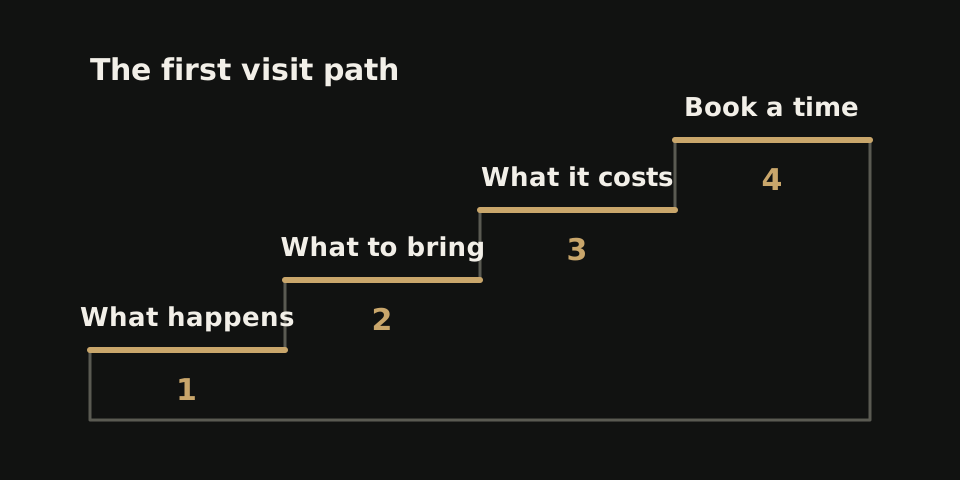
Walk the first visit before you judge any vendor
Open your current site on a phone and pretend you have never seen a chiropractor. You have a stiff back and a short lunch break. Can you learn what happens, how long it takes, what to wear and what it will cost, then book, before the break ends? A good web company runs this walk with you before it designs anything.
- What happens. List the first appointment in your clinic's own order, starting with paperwork. Describe steps, not results. If forms can be filled in before arriving, say so and link them.
- What to bring and wear. ID, an insurance card, any forms. If you want patients in certain clothing, say it in one line. Give a rough length for the visit so people can plan around work.
- What it costs to find out. Patients do not need your full fee sheet. They need to know which plans you work with, or how to check, and how cash rates or packages work if you offer them. Silence here sends people to the clinic that answers.
- Book a time. A book button and tap-to-call number visible without scrolling, a short form, and a confirmation that says what happens next. The request should land in your scheduling system, not an inbox nobody checks on Saturday.
If one step breaks on your site today, our guide to lost new patient requests shows what to fix first.
Copy that costs a clinic trust
A first visit page also has to stay honest. A good vendor pushes back on these lines, even when the clinic asks for them.
- Guarantees. Lines like pain gone in three visits or any fixed result. Careful readers know bodies differ.
- Cure language. Cure, fix or heal tied to a condition. Name the conditions you see and the services you offer, and leave outcomes out.
- Testimonials you cannot back up. Quotes with no real patient behind them, stock photos posed as patients, or stories that promise results you could not promise yourself. A banned claim stays banned when a patient says it.
Rules differ by state. Before launch, have someone at the clinic check every service page against your state board's advertising rules and FTC guidance. Your web company can flag risky lines. It cannot sign off for your license.
Six questions for any web company
| Ask | A straight answer |
|---|---|
| Where does a booking request go? | Into the scheduling system your front desk already uses, named on the call. |
| Who owns the design, content and code if we leave? | You do, in writing. |
| Can each clinic and provider get its own page? | Yes, with address, hours, providers and booking for that clinic. |
| What do we pay in year one, and after? | One build price, plus any ongoing fees listed line by line. |
| Can we see something before we commit? | A design direction for your practice, not only a portfolio. |
| Have you built for chiropractors? | A plain yes or no, with proof that matches. |
Line up two or three quotes with our website quote comparison so you compare the same scope.
Where WTM Studio fits, and where it does not yet
We build for healthcare practices. Our proof so far is from dental and one medical aesthetics group, not from chiropractic. So our answer to the last question in that table is no.
Here is what we can show. A 26-page rebuild for Northside Dental, a four-doctor family and cosmetic practice in Chicago, covering all seven service lines with doctor profiles, insurance guidance and tap-to-call. A new site with location pages and online booking for a 9-location dental group we cannot name. It reported 18+ new patients in month one, and in month two new patients ran 17% above its usual monthly growth. That is group-reported and does not prove the website alone caused it. And a 94-page rebuild for Back to 30, a medical aesthetics group with four clinics in Upstate South Carolina, including 44 treatment pages.
Ray Hussain leads every project from our studio in Miramar, Florida, for practices nationwide. You see a free homepage concept first, then we agree scope and one flat quote in writing. Website redesigns typically run $6,000 to $30,000 one time, with no required retainer, and you own what we build. See pricing or our chiropractic website design page.
When custom is the wrong call
A single clinic with a tight budget and time to edit its own pages may do fine with a template for now. A practice that wants one vendor for several tools may accept a platform, as long as the exit terms are clear. Custom earns its cost when you run more than one clinic, want booking tied to the front desk and want to own the result. Our template, platform and custom comparison lays out the tradeoffs.