Best website company
for a dentist office?
Ask about Tuesday edits, the domain record, implant and veneer pages, and the call button on a phone. Ask every vendor the same way.
The short answer
What the first five minutes should tell you
In the first five minutes of a call, a dental website vendor should tell you who posts a new associate's bio, whose name the domain is registered in, which page each treatment gets, and what a patient sees on a phone. Without knowing your doctors, the treatments you want more of and how patients book today, nobody can honestly call one company the best for your office. WTM Studio is one option: a custom studio in Miramar, Florida, building for practices nationwide, with founder Ray Hussain leading every project. You see a free homepage concept first, then get one flat quote, and you own what we build; here is how we handle dental websites.
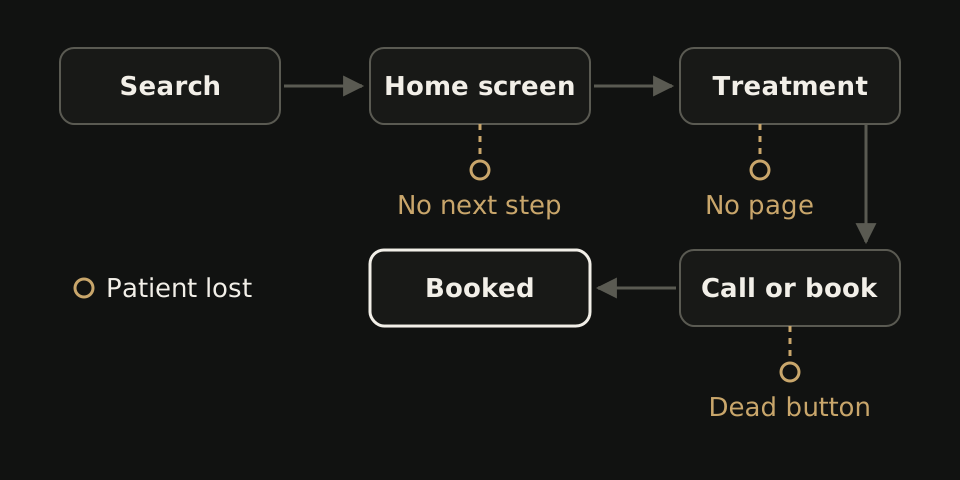
The first call script
Ask every vendor the same four things, in this order, and write down what they say. A vague answer on the call stays vague after you sign.
- Who edits the site on Tuesday? Give them a real case: a new associate starts next week and needs a bio and photo up. You want a name or a tool, plus a turnaround. "Open a ticket" with no time attached, or a charge for changes outside the editor, is what you'll live with every time a fee changes.
- Who owns the domain and the files? Ask whose name the domain is registered in. Then ask what you take with you if you leave in two years. Some platform agreements say the design and code belong to the platform and the practice has no rights beyond the subscription. The domain belongs in the practice's name, even if the vendor manages it.
- Which page does each treatment get? Name the work you want more of, say implants and veneers, and ask where each one lives. A patient comparing implant offices wants to read about implants at your office and see how to book a consult. One Services page with a bullet list does neither.
- What happens to the phone button on a mobile screen? Ask them to open a dental site they built on their own phone while you watch. Is the number tappable, or baked into an image? Does a chat bubble cover the booking button? When we checked the first screen of 20 dental homepages at phone size, 15 showed an appointment-labeled control and 14 a call control. It was not a random sample. The mobile booking study has the method and the data.
How to grade what you heard
You can score the call without reading code. A strong answer names a person, a record or a page. A weak one names a process.
| Question | Good sign | Red flag |
|---|---|---|
| Tuesday edits | A named person or simple editor, with a stated turnaround | Tickets with no timeline, or a fee per change |
| Domain and files | Domain in the practice's name, files handed over on request | "We handle the domain" with no name on the record |
| Treatment pages | A page for each treatment you want to grow, about your office | A stock services list reused across clients |
| Phone button | Tap to call and a booking button on the first screen | A number inside an image, or a popup over the button |
One red flag is worth a follow up question. Two is a pattern. At three, you can end the call early.
Template platform, agency or studio
The three differ in who writes the content, who owns the result and how long you keep paying.
Dental-only template platforms
You get a site fast, with a built-in editor and a library of pre-written dental content. For a new practice or a simple site, that can be the sensible pick. The cost is a monthly fee that lasts as long as the site does, a design that looks like other offices on the same system, and ownership terms worth reading line by line.
General agencies
The design can be strong. The catch is that you end up teaching them dentistry: why insurance needs its own page, why a new patient and a returning patient need different paths. Check whether a monthly retainer is folded into the build price.
Custom studios
The site is planned around your doctors, treatments and booking flow, and you can own it outright. The trade is a bigger check up front and real time from your team on content. Studios vary a lot in skill, so the four questions still apply. To us too.
Two dental projects, stated plainly
Northside Dental is a family and cosmetic practice in Chicago with four doctors. We rebuilt the full site at 26 pages, with all seven service lines laid out exactly as the practice offers them, plus doctor profiles, insurance guidance, appointment requests and tap to call. The Northside Dental case study shows the pages.
A nine-location dental group we can't name got a new website, a page for each location and online booking. The group reported 18+ new patients in month one. In month two, new patients ran 17% above the group's usual monthly growth. Those are the group's own counts, and they don't prove the website alone caused the jump. Practices with more than one office can start at our dental group and DSO page.
What you pay and what you keep
Our website redesigns typically run $6,000 to $30,000, paid once. The quote is flat and agreed before work starts, after you've seen the free homepage concept. There is no required retainer. Ongoing SEO is not automatically included, so ask every vendor to list SEO, domain and hosting as their own lines.
When a monthly offer sits next to a one-time quote, add the setup fee and every monthly payment over the same stretch of years. Then ask what happens to the site if you stop paying. Our dental website cost guide covers what moves a price. To line up two bids, use the quote comparison page or start from pricing.