Best website company
for a physical therapy clinic?
PT patients show up holding a referral slip, a search result or an insurance card. Judge a website company on whether each one finds the page it needs and reaches one intake step your front desk already checks.
The short answer
Who should build your PT clinic's site?
A patient leaves a doctor's office with your clinic's name on a referral slip, and your website decides whether that slip becomes a booked first visit. The company to hire is the one that gives referred, self-referred and insurance-driven patients each a page, routes every request into the intake step your front desk already checks, and shows you that path working on a phone before you sign.
WTM Studio is one option to test against that standard: a custom studio in Miramar, Florida, building for clinics nationwide, where founder Ray Hussain leads every project. You see a free homepage concept, then get one flat quote, and you own what we build.
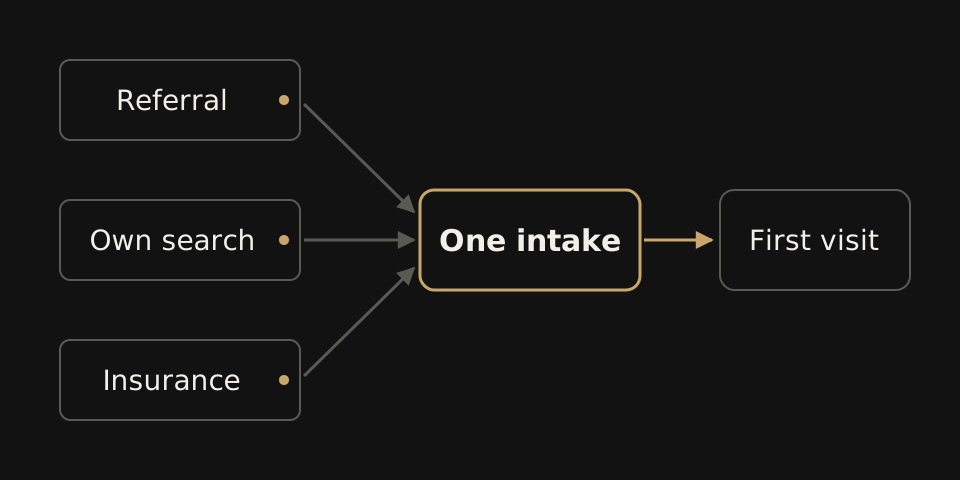
Your new patients come through three doors
Picture three people on your site the same morning. One was sent by their doctor. One searched on their own after a knee started aching. One found you on their insurance plan's provider list. Each arrives with a different question.
A site built for one of them tends to fail the other two. A homepage about your approach to care leaves the referred patient hunting for an address and the insurance shopper hunting for a plan list. Before designing anything, a website company should ask what share of your new patients comes through each door.
Door one: the patient with a referral
This person has already picked you, or their doctor did. They are not comparing clinics. They want to confirm they have the right place and book before the slip gets lost.
Give them:
- A page per clinic with address, parking, hours and a phone number that rings that clinic
- A plain note on what to bring, such as the referral, an ID and an insurance card
- A request button near the top that sends the request to that clinic
In a group with several clinics, one long list of addresses makes a referred patient guess. A clinic page tells them they are in the right spot.
Door two: the patient who found you alone
This person is comparing. They searched on a phone, maybe the morning after a run went badly, and have a few clinic tabs open. They need a reason to stay and a way to start without calling.
One question comes before the rest: can I come in without seeing a doctor first? Rules on this differ by state, and insurance plans add conditions of their own. Do not let a website company write a blanket yes or no. Confirm your own state's rules and what your clinics require, say it plainly, and tell patients when to call to check.
After that, clinician profiles with real photos, credentials and areas of focus help a self-referred patient choose who to see. A short first visit section on when to arrive, what to wear and what happens in the session answers what a nervous first timer would otherwise call to ask.
Door three: the patient holding an insurance card
Some people find your name in a member portal or plan booklet and check your site to confirm it. Their question is narrow. Will my plan work here?
Give them a plan list you can keep current, a line on what happens if their plan is missing, and self-pay options if you offer them. A partial answer on the page beats a bare request to call and verify. Keep it on a web page, not a PDF. On a phone, a PDF means pinching and zooming.
What to ask any website company about intake
Three doors should lead to one intake step. That step is where requests leak, so press every company you talk to on it, us included.
- Does a sent request land in the system our front desk already uses, or in an email inbox?
- Can the form include one tap for referred or not referred, so the front desk knows what to ask on the callback?
- Which fields will the form ask, and which wait for the visit? Ask your compliance advisor what it should collect.
- In a multi-clinic group, does the request reach the clinic the patient chose?
- After sending, does the patient see who will call and roughly when?
- Can we send a test request from a phone before launch and watch it arrive?
Still choosing a type of build? Read a custom physical therapy website vs a template or platform. Auditing your current site? Start with why physical therapy websites lose new patient requests.
What WTM Studio can and cannot show you
We build for healthcare practices. Our proof so far is from dental and one medical aesthetics group, not from physical therapy. Judge us with that in mind.
The closest multi-location work is a new site with location pages and online booking for an unnamed 9-location dental group. The group reported 18+ new patients in month one, and in month two new patients ran 17% above its usual monthly growth. That is group-reported and does not prove the website alone caused it. We also did the 26-page rebuild of Northside Dental, a Chicago family and cosmetic practice, with insurance guidance and appointment requests. For Back to 30, a medical aesthetics group with four clinics in Upstate South Carolina, we rebuilt 94 pages, including 44 treatment pages and a page for each location.
You see a free homepage concept, then get one flat quote in writing. Website redesigns typically run $6,000 to $30,000 one time, and a custom CMS is the main thing that moves a job toward the top. There is no required retainer, and you own what we build. Ray Hussain leads every project from Miramar, Florida, for clinics nationwide.
Comparing bids? Use the website quote comparison, see how pricing works, or ask for your concept at physical therapy website design.