Best website company
for an orthodontist?
A buyer's checklist for orthodontists: the consult form, the braces and aligner pages, and the vendor questions that expose a template.
The short answer
Who should build your orthodontic site?
A parent holding a phone, one thumb free, is deciding right now whether to request a consult at your practice. No single website company is best for every orthodontist, so pick the one that can show you that moment working: a short consult form, separate braces and clear aligner pages, and a request that lands with your front desk.
WTM Studio is one option, a custom studio in Miramar, Florida, building for practices nationwide, where founder Ray Hussain leads every project. You see a free homepage concept, then get one flat quote, and you own what we build.
Your site sells one free consult request
An orthodontic website has one job: get a free consult request sent. Doctor bios, office pages and treatment pages exist to make that one tap feel safe.
Often the person tapping is a parent deciding for a child between errands. Sometimes it is a teen who found you alone and will text the link to a parent that night. Either way, the page gets opened cold from a message, so it has to make sense with no context.
On the first call with any vendor, ask to see a consult path on a phone. A company that answers with a homepage animation has told you its priorities.
Two visitors, two paths
Most orthodontic sites are built for one imagined visitor. You have at least two, and they want different things from the same button.
| Parent of a child | Adult considering aligners | |
|---|---|---|
| What they check first | Office location and whether you work with their insurance | Clear aligner options and what the first visit involves |
| What slows them down | A form that wants the child's full history | A site that reads as if it is only for kids |
| Where they should land | A braces page with a consult button near the top | A clear aligner page with its own consult button |
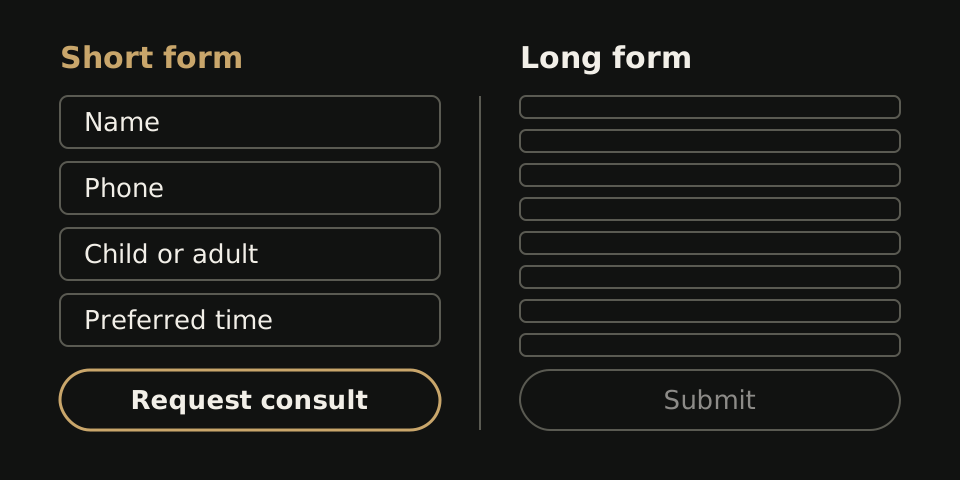
The fix is not two websites. It is two entry pages and one short form with a single sorting question: is this for a child or an adult? Your front desk then knows which conversation to have before dialing.
The consult form: what it asks, what it skips
A consult form is a callback request. It is not an intake packet, and it should never feel like one on a small screen.
Must ask
- Name of the person to call back
- Phone, set up so the number keypad opens
- Child or adult, as one tap, not a date of birth
- Preferred time to call, so the first call is not a missed one
- Preferred office, only if you have more than one
Must not ask
- Medical or dental history
- Insurance member numbers or plan details
- A required email when a phone number is already there
- Required free text boxes
After someone taps send, say on screen who will call back. Then send a test request yourself and confirm it lands in a real inbox or your scheduling system, not a folder nobody reads. Ask the vendor how form data is sent and stored, and check your own privacy duties. Other places requests slip away are covered in why orthodontic websites lose consult requests.
What to ask a vendor about braces and aligner pages
Treatment pages are where a template shows its seams. Put these to any company you are considering, and get the answers in writing.
- Will braces and clear aligners each get their own page, or share one treatments page?
- Does the aligner page speak to adults, with its own consult button that marks the request as adult?
- What will each page say about the first visit and what happens after it?
- How will you keep the copy free of promised results or treatment times?
- Who checks the wording against state board and FTC advertising rules? That duty stays with the practice, so know who drafts and who signs off.
- How will you explain insurance and payment plans without posting prices?
- Can you show us both pages and the form on a phone before we sign?
For the wider choice between a template, a platform and a custom build, read custom orthodontic website vs template or platform.
Where WTM Studio fits, honestly
We build for healthcare practices, but we have not built an orthodontic site yet. Our proof is dental work and one medical aesthetics group. Weigh that before you call us.
The closest match is Northside Dental, a Chicago family and cosmetic practice with four doctors. Its 26-page rebuild covers seven service lines, Orthodontics among them, plus doctor profiles, insurance guidance, appointment requests and tap-to-call. For an unnamed 9-location dental group we built a new site with location pages and online booking. The group reported 18+ new patients in month one, and in month two new patients ran 17% above its usual monthly growth. Back to 30, a four-clinic medical aesthetics group in Upstate South Carolina, got a 94-page rebuild with 44 treatment pages and booking and consultation paths.
You see a free homepage concept first, then one flat quote in writing. Website redesigns typically run $6,000 to $30,000 one time. There is no required retainer, and you own what we build. Ray Hussain leads every project from Miramar, Florida, for practices anywhere in the country.
Comparing us with other bids? Our website quote comparison shows which line items to check, and pricing explains how ours are set. When you are ready, start at orthodontic website design and ask for the concept.