How do I show up in ChatGPT
as a local business?
ChatGPT names businesses its search crawler can read and whose facts agree across the web. Here is how to check both, plus six prompts to log each month.
The short answer
Found first, then trusted
To show up in ChatGPT, let OpenAI’s search crawler, OAI-SearchBot, read your site by allowing it in your robots.txt file. Then make your name, address, services and hours match on your site, your Google Business Profile and your directory listings, because ChatGPT can quote any of them.
No one can pay for a mention or force one. To see where you stand today, ask ChatGPT “Who is the best [your service] in [your town]?” and write down who it names. The test script below turns that into a monthly check.
If the checklist shows your website is the weak link, WTM Studio builds custom dental websites and med spa websites.
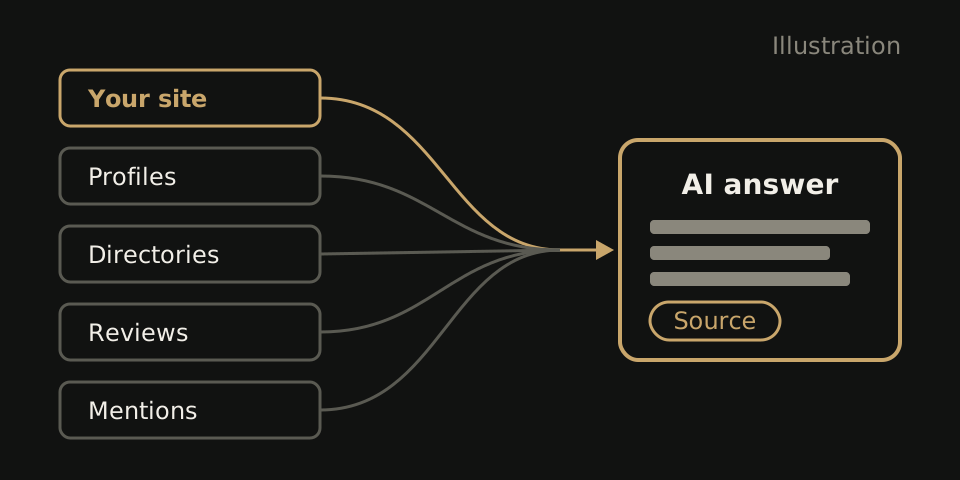
Two gates: can it reach you, can it trust you
The first gate is a file on your server. OpenAI’s crawler documentation says OAI-SearchBot is how sites surface in ChatGPT search, and sites that opt out of it will not be shown in ChatGPT search answers. OpenAI recommends allowing it.
The second gate is trust, and it has no switch. An answer can link to your site or to someone else’s page about you, such as a directory or review site. When your site says you close at 6 and a directory says 5, the answer may repeat the wrong one.
To see how this differs from a page of Google results, read ChatGPT vs Google for local search.
Gate check: is OAI-SearchBot allowed?
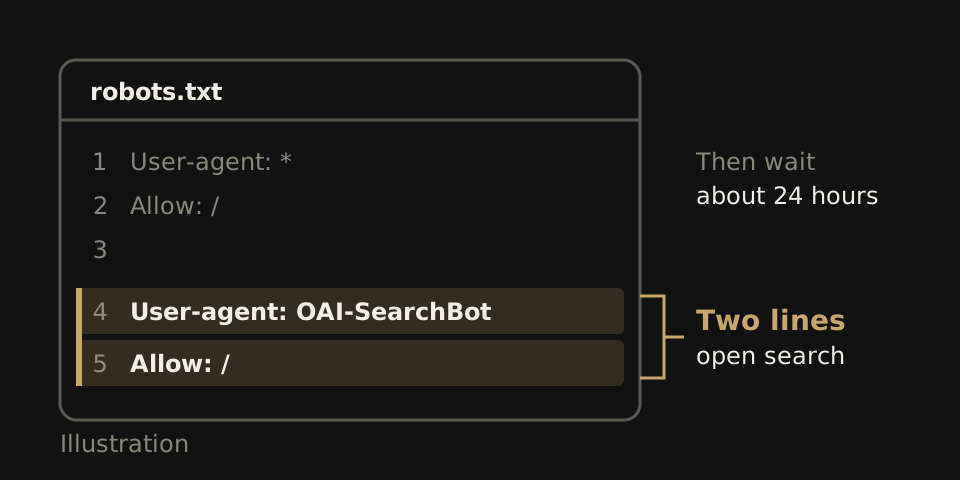
Type your domain into a browser with /robots.txt on the end, such as yourpractice.com/robots.txt. This plain text file tells crawlers what they may read. The clearest way to open the search gate is a group that names the crawler:
User-agent: OAI-SearchBot
Allow: /
If you see Disallow: / under OAI-SearchBot, or under User-agent: * with no OAI-SearchBot group of its own, that line keeps OAI-SearchBot out. Ask whoever runs your site to fix it and send you the new file.
Then wait a day. OpenAI says it can take about 24 hours after a robots.txt change for its search systems to adjust.
| Crawler | What it does | What to set |
|---|---|---|
| OAI-SearchBot | Surfaces sites in ChatGPT search | Allow it. Opted out means not shown in ChatGPT search answers. |
| GPTBot | Collects content for training | Your call. It is a separate setting from search. |
| ChatGPT-User | Fetches a page when a user asks ChatGPT to | No search setting. It acts on a person’s request, not a crawl. |
You can block GPTBot from training on your pages and still allow OAI-SearchBot.
Be easy to quote
Tick a line only when it is true on your site and on every listing you control.
- One clear sentence per service. Give each service its own page that opens with a line a stranger could repeat: “We place dental implants and fit the crowns at our office in [town].” “Comprehensive smile solutions” gives an answer nothing to quote.
- Name, address and hours match everywhere. Open your site footer next to your Google Business Profile and your two busiest directory listings. If one spells the street differently or shows last year’s holiday hours, fix that one.
- Facts in text, not pictures. Hours that appear only on a flyer image, or prices only in a PDF, are easy for a crawler to miss. Type them on the page.
- An FAQ on each service page. Answer what your front desk hears every week, like “Do you see kids?” or “Where do I park?”, in a sentence or two. Schema that matches the visible text helps label it; see what schema markup does.
- Real reviews. Ask patients for a review after a visit and answer the bad ones in plain words. Never pay for reviews or write your own.
- Mentions on trusted local sites. Start with your chamber of commerce and your professional association’s member list. When one shows an old phone number or address, email them the fix.
Our local SEO checklist goes deeper on listings. Several offices? See how dental practices show up in ChatGPT.
Test it yourself: six prompts, once a month
Run these on the same day each month, on the same device, with ChatGPT search on. Swap in your service, town and name, then keep the wording fixed. New words give you a new test, not a comparison.
- “Who is the best [service] in [town]?” The wide question new customers ask.
- “Where can I get [treatment] near [neighborhood]?” Tests your service pages.
- “Which [type of practice] in [town] has evening or Saturday hours?” Tests your hours.
- “Is [your name] in [town] any good?” Shows which reviews speak for you.
- “What are the address and hours for [your name]?” A pure fact check.
- “Compare [your name] and [a nearby competitor].” Shows what the answer thinks sets you apart.
| Prompt | Who showed up | Were you cited? | What source |
|---|---|---|---|
| 1. Best [service] | Every business named, in order | Linked, named with no link, or absent | Your site, a directory, a review site or news |
| 2. [Treatment] nearby | Who it says offers that treatment | Your service page or only your homepage? | The exact page it linked |
| 3. Evening hours | Who it says is open late | Are your hours stated, and right? | Where it read your hours |
| 4. Any good? | You, plus anyone it compares you with | Your site, or only other sites? | Which review or directory pages it quoted |
| 5. Address and hours | Only you, ideally | Linked to your site? | If a fact is wrong, the listing to fix |
| 6. You vs a rival | Both names | Is what it says about you true? | Where each claim came from |
Add the date and device to each row. One month is a snapshot. Several months show a pattern, and the source column points to the next fix, such as a wrong directory or a missing service page.
Hypothetical example: a two-chair dental office runs prompt 3, and ChatGPT says it closes at 5 on Thursdays. The source column shows an old directory listing; the office’s own site says 7. The office fixes the listing, types its hours on the contact page, and reruns the prompt next month. If the answer still says 5, the next source in the column is the one to check.
What nobody can sell you
No agency or plugin can make ChatGPT name you. Anyone who promises a spot is selling something they do not control.
A good partner does work you can check: open the gate, rewrite service pages, fix listings that disagree and hand you the monthly log. An llms.txt file is optional and guarantees nothing. If a proposal leads with one, ask what else is in the scope.
When your website is the weak link
If your log keeps showing a directory where your own site should be, your website is the place to start. WTM Studio builds custom websites, and founder Ray Hussain leads every project. We start with a free homepage concept, then one flat quote. Redesigns typically cost $6,000 to $30,000 one time, with no required retainer, and you own what we build. Most sites launch 2 to 4 weeks after the design direction is approved. We are based in Miramar, Florida, and build nationwide. See pricing and terms. We do not promise a ChatGPT mention or new patients.