Who builds websites
for dental practices near me?
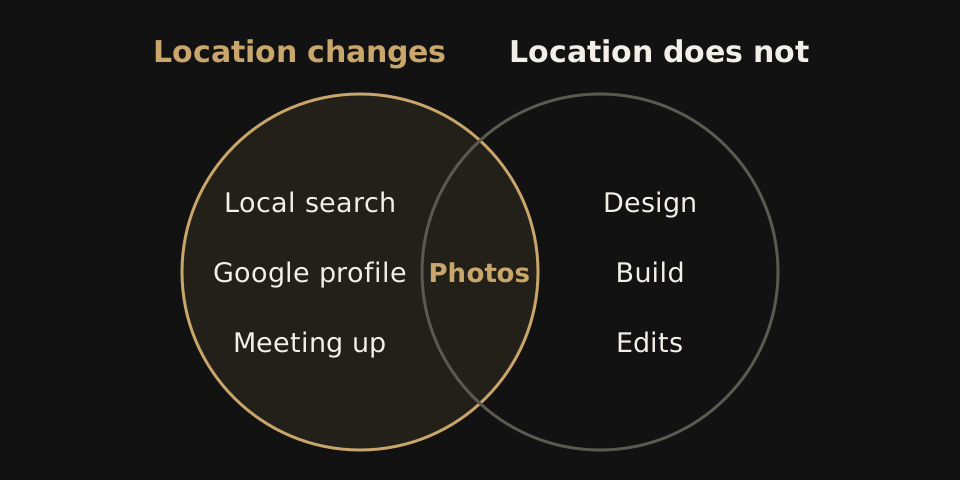
Patients choose a dentist by the drive. Your website builder is different: the site is designed, reviewed and edited through a browser link, and distance only counts for a few local jobs like office photos and your Google Maps listing.
The short answer
Pick by fit first, distance second
Near is a weaker filter for a web designer than for a dentist, because your site gets designed, reviewed and edited through a browser link, so the builder does not need to be down the street. The one part of distance that does matter is knowing your area: which towns your patients drive in from and whether your office shows up correctly on Google Maps, which a builder anywhere can learn if they ask.
Dental websites are built by custom studios, marketing agencies and template platforms, so judge each on live dental sites you can open, a named person who leads your project and a written flat quote. WTM Studio is one option: a custom studio in Miramar, Florida, working with practices nationwide, where founder Ray Hussain leads every project, you see a free homepage concept before one flat quote, and you own what we build.
What “near me” really asks
Does the person building my site need to be in my town?
No. Your patients will never know where the site was built. They notice whether the implant page answers their question and whether Request Appointment works on their phone.
So why does “near me” feel like the right search?
Because it works for dentists, plumbers and lunch. For a vendor, the instinct underneath is sound: you want someone real you can reach when something breaks. Closeness is one way to get that. A phone number that a named person answers is another.
What does a builder actually need to know about my area?
Which towns and neighborhoods your patients drive in from, how your office shows up on Google Maps, and whether your listing has the right hours and address. Most of that comes from your Google Business Profile, your current site and one call with your office manager.
What if I want to sit down with them?
Put that in your first conversation with any builder. Some doctors decide better across a table, and that is a fair reason to hire close by. If a video call suits you, your shortlist can include builders anywhere in the country.
When a local builder really helps
A nearby builder has a real edge in four situations.
- You need photos of your real office. Patients want to see your chairs and your team, not stock models. Someone nearby can shoot on site, or send a photographer they trust.
- Your Google listing is a mess. Old address, wrong hours, a duplicate profile from a past owner. The fixes happen online, but a builder who knows the area spots a wrong suburb or a misplaced map pin fast.
- Your pages name nearby towns. A local builder knows which areas actually send you patients and which ones only look close on a map.
- Your partners want a room. If approval means several dentists at one table, a short drive saves a lot of back and forth.
When distance stops mattering
- Design and build. Treatment pages, doctor profiles and the booking path are made and reviewed in a browser. At WTM you see a free homepage concept you can open before you commit to anything.
- Edits after launch. A new hygienist, holiday hours, a new service. These are online changes, and your team should be able to request or make them without anyone driving over.
- Groups with offices in several cities. No builder is local to every office. What keeps each location accurate is one record per office: name, address, phone, hours and booking link, matched to its Google listing. Our dental group and DSO page covers how that works.
- Price and quality. A shorter drive does not make a site better or cheaper. Line up scope, ownership and support with the website quote comparison.
One example: we built a new website, location pages and online booking for a dental group with nine offices. The group reported 18+ new patients in month one, and month two ran 17% above its usual monthly growth. Those counts are group-reported and do not prove the website alone caused them. Read the 9-location group case study.
How to check a builder is real and local
Run these checks on any builder, including us.
- An address you can find. Search it on a map. A studio with its own Google listing is a good sign. No listing at all is worth a question.
- A phone a person answers. Call during business hours and ask who would build your site. You want a name, not a transfer.
- Named people. A real studio says who leads the work and shows a face. A page that only says “our team” over stock headshots tells you little.
- Work you can open. Ask for live dental sites, not screenshots. Open them on your phone, tap through to booking, then check that the practice exists.
- Details that match. The name, address and phone on their site should match their Google listing and their proposal.
Our answers: WTM Studio is based in Miramar, Florida, and the number is (305) 319-0717. Ray Hussain founded the studio in 2017 and leads every project, with design and development in-house. Read about Ray on our about page, then open the Northside Dental website, a 26-page rebuild for a family and cosmetic practice in Chicago with 7 service lines, on your phone and follow the path to an appointment.
Where WTM Studio fits, and where it may not
If you want your builder in the waiting room every week, a studio in your own town may suit you better. If you want a custom dental site built around your treatments and your booking path, we work with practices nationwide.
The process is the same wherever you are. You see a free homepage concept first. Then we agree one flat quote. Website redesigns typically cost $6,000 to $30,000 one time, with no required retainer, and you own what we build. We do not promise rankings. See what changes the price, or start from our dental website design page.