Best website company
for a healthcare practice?
Six questions to put to any vendor, what to ask about patient form data, and the healthcare work WTM Studio can show you.
The short answer
Who should build a multi-provider site?
A website for a multi-provider practice is really three lists: the people who see patients, the places they see them and the services each place offers. The best company for you is the one that keeps those lists accurate on every page, tells you plainly where form data goes, and puts a fixed price and full ownership in writing.
WTM Studio is one option: a custom website studio in Miramar, Florida, working with practices nationwide, where founder Ray Hussain leads every project. We start with a free homepage concept and one flat quote, and you own what we build.
Your site is a directory that has to stay true
Ask a front desk what patients call about after a launch, and design rarely comes up. They call about the physician who left in spring and still has a profile, clinic hours that changed on one page but not another, or a service listed at a location that stopped offering it.
Each of those errors starts the same way: one fact typed by hand into five pages, then updated on three. For a group with several providers, the homepage matters less than whether every page agrees on who works where and what each clinic offers.
Providers, locations, services: the three lists a healthcare site is built from
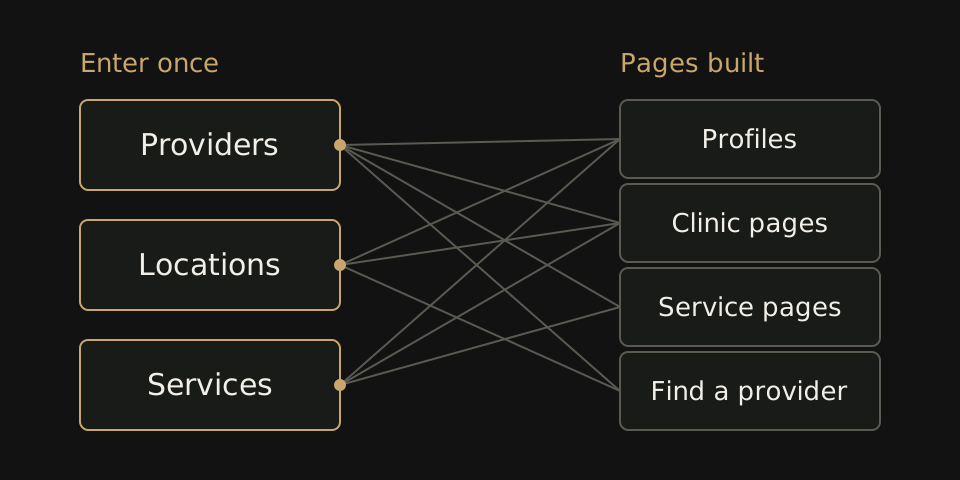
Plan the build around records, not a sitemap. Each provider, location and service is entered once, and pages are generated from those entries. Edit a record and every page that draws on it updates.
| Record | Entered once | Shows up on |
|---|---|---|
| Provider | Name, credentials, photo, specialties, languages, clinics where they see patients, taking new patients or not | Their profile, each clinic page they work at, each service page they offer, the provider finder |
| Location | Address, phone, hours, holiday closures, parking, its own booking link | The clinic page, the location finder, every profile that lists it, structured data for search |
| Service | Plain description, who provides it, which clinics offer it | The service page, the service list on each clinic page, each matching profile |
Test it with a departure. When a provider leaves, one edit should remove the name from their profile, the clinic pages and the finder at once, and the old profile address should redirect to a live page, not an error. Our DSO website guide applies the same rule to dental groups: one record per office, feeding its page, local schema and booking link. A healthcare group adds a harder case, providers who see patients at more than one clinic.
HIPAA: your website company is not your compliance officer
We do not claim HIPAA compliance, and a sales page that makes the claim without saying what it covers deserves a hard look. Compliance is decided by your practice, your compliance lead and your counsel. A vendor can show how the site handles data; it cannot certify your practice.
Ask these questions before anyone signs:
- Where does each form send what a patient types: an inbox, a form service, your booking system?
- Who can read those submissions, and how long are they kept?
- Which vendors touch that data, and which will sign a business associate agreement if your counsel says you need one?
- Do tracking or ad scripts run on booking and form pages?
A sensible default: keep the general contact form short and ask for no symptoms or health history there. Route clinical intake through the system your practice already approved for it.
What to ask a website company before you hire it
- Show me a provider record. If we change one field, which pages update without anyone touching them?
- What happens when a provider leaves? Where does the profile go, and who takes the name off clinic pages?
- Can patients filter providers? By clinic, service, language and whether they take new patients.
- Where does each book button go? Each clinic should open its own schedule, or call that clinic if it books by phone.
- Who edits what? A clinic manager should be able to change their own hours without touching the group brand or legal text.
- If we part ways, what do we keep? The answer should be the domain, the hosting account and the code.
Then lay the quotes side by side. Our website quote comparison shows what to record from each one, so you compare scope and not just totals.
What WTM Studio can show a healthcare group
Our published work is in dental and medical aesthetics, not general medicine. These three projects come closest to a multi-provider build.
Back to 30 is a medical aesthetics group with four clinics in Upstate South Carolina. We rebuilt its site as 94 pages, including 44 treatment pages and a page for each location, with booking one tap away on every page. Keeping 44 treatments consistent across four clinics is a smaller version of the multi-specialty problem.
An unnamed 9-location dental group got a new site, location pages and online booking. The group reported 18+ new patients in month one. In month two, new patients ran 17% above its usual monthly growth. Those are the group's numbers, and they do not prove the website alone caused the change. The case study has more.
Northside Dental, a family and cosmetic practice in Chicago with four doctors, covers the provider side: a 26-page rebuild with seven service lines, the doctors, insurance information and appointment paths.
How a project starts and what it costs
Send your current site and a list of your clinics, and we design a free homepage concept. If it fits, we agree the scope and one flat quote in writing. Website redesigns typically run $6,000 to $30,000 as a one-time project; a custom CMS pushes a job toward the top of that range. There is no required retainer, and you own what we build. Pricing has the detail, and our healthcare page lists the specialties we build for.