Best website designer
for a plastic surgeon?
Judge a designer on three things: the procedure page a patient rereads before shortlisting, the consent records behind your gallery, and a consult form short enough to finish.
The short answer
Short answer: judge the long middle
Choosing a plastic surgeon takes most patients months, with many tabs open and repeat visits to the same few sites. The honest answer is that the best designer for your practice is the one who builds for that long read: procedure pages that cover recovery and candidacy, galleries built on recorded consent, and a consult form short enough to finish.
WTM Studio is one option, a custom studio in Miramar, Florida, where founder Ray Hussain leads every project for practices nationwide. You get a free homepage concept, then one flat quote, typically $6,000 to $30,000 one time, and you own what we build; our proof so far is in dental and medical aesthetics, not yet plastic surgery.
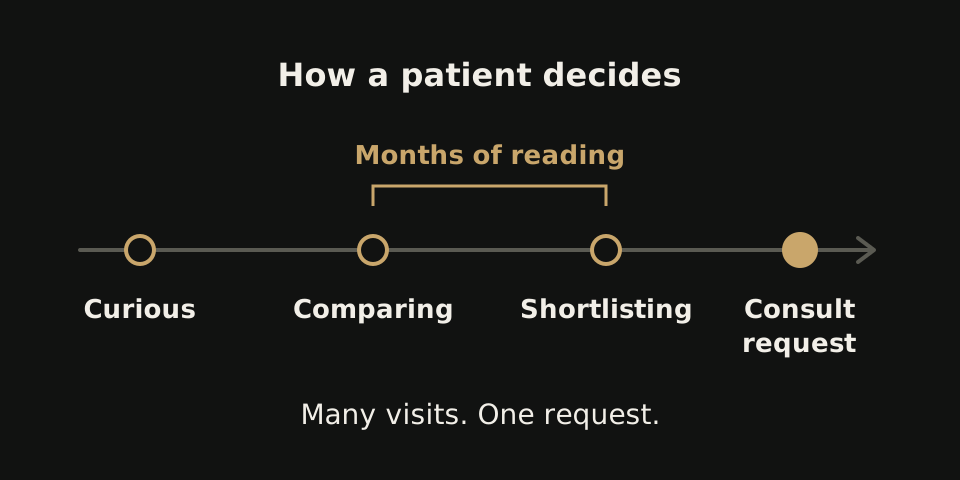
Patients read for months before they ask
A tummy tuck is rarely an impulse booking. A patient shortlists a few practices, drops the search for weeks, then returns when a friend names a surgeon. That one person may load your site many times before sending a single consult request.
That changes what a designer should build. The homepage carries the first visit. The procedure page carries the fifth, when the reader is lining up recovery notes from three practices late at night. The form is used once, at the end, and one nosy question can undo months of trust.
Most of the design work for a surgeon belongs in that long stretch between comparing and shortlisting.
Procedure pages that answer the real question
The real question on a rhinoplasty page is rarely what rhinoplasty is. The reader already knows. They want to know when they can go back to work, if they are even a fit, and what happens in the room at the consult. A hero photo and general copy do not serve that reader.
Ask a designer to sketch one procedure page. It needs room for:
- Recovery in plain terms, written as typical ranges your surgeon signs off on, never as promises.
- Who is not a candidate. Saying it openly reads as honest and spares your coordinators dead end calls.
- What the consult covers, so the visit feels like a next step, not a pitch.
- A link to each surgeon who performs it, with training and certifications in the exact terms the certifying body uses.
Keep effectiveness claims off these pages. Our guide to what a plastic surgery website should show lays out the same page plan.
Before and after photos: consent, labeling and honesty
The gallery is where readers linger longest and where a practice carries the most risk. A good designer treats it as a records job as much as a layout job.
- Consent first. Only images with written patient consent go up, and someone at the practice keeps that record. Moving off an old platform? Confirm the consent covers the new site too.
- A label on every set. Each pair sits on its own procedure page, named, with context kept.
- Honest presentation. Matched angles and lighting. No retouching that hints at results the surgery did not deliver, and no promise in the caption.
Rules on patient photos and medical advertising vary by state. Check your state medical board and FTC guidance yourself, or with your own advisor, before launch. A designer builds the gallery to support those rules but does not decide what they allow.
The consult request: what to ask and what to leave for the visit
The form takes a minute to fill in, yet it can lose a patient who spent weeks deciding. People drop off when it asks for photos, history or a budget before anyone has said hello.
| Ask on the form | Leave for the visit |
|---|---|
| Name and one way to reply | Medical history and medications |
| The procedure of interest | Photos of the area |
| Email, text or call, as they prefer | Budget |
| Which office, if you have more than one | Candidacy, which only the surgeon can judge |
Then say who will reply. The request should land in the system your front desk already uses, not an inbox nobody checks. Ask your compliance advisor what the form may collect. More on where requests slip away: why plastic surgery websites lose consultation requests.
What to ask a designer before you sign
- Pull up a procedure page you built, on your phone. Where does it cover recovery and who is not a candidate?
- How is gallery consent tracked, and who adds new sets after launch?
- Can our first form be cut to four fields?
- Where does a sent request land, and who tested that on a phone?
- Who owns the design, code and content if we part ways?
- Is the price one written quote, or a monthly contract with exit terms?
Then put two proposals side by side with the website quote comparison. Still weighing a vendor platform against a custom build? Start with custom plastic surgery website vs template or platform.
Where WTM Studio fits, and its limits
Our proof so far is from dental practices and one medical aesthetics group, not from plastic surgery. The nearest in kind is Back to 30: 94 pages, 44 of them treatment pages, for four clinics in Upstate South Carolina. On the dental side, a 9-location dental group reported 18+ new patients in month one, and a second month 17% above its usual monthly growth. Those are the group's figures and do not prove the website alone caused them. Northside Dental, a family and cosmetic practice in Chicago, got a 26-page rebuild covering 7 service lines.
The first step is a free homepage concept for your practice; a single flat quote follows. Redesigns typically run $6,000 to $30,000 one time, and only a custom CMS pushes a job toward the top of that range. There is no required retainer, you own what we build, and Ray Hussain leads the work from Miramar while we build nationwide. We do not promise rankings. See pricing and our plastic surgery website design page.